Sign up to the newsletter
Buy tickets now
Carl Craig: the spirit of 69, by Philip Sherburne

Carl Craig: the spirit of 69, by Philip Sherburne

One of the legendary Detroit producer’s most important projects, Carl Craig will be bringing 69 to the live stage exclusively at Field Day 2011. Philip Sherburne charts his alter-ego’s history and reveals a sneak peek at what’s in store…

Nineteen sixty-nine was a crazy year. Astronauts landed on the moon, and Ohio’s Cuyahoga River caught fire. The war in Vietnam was spinning out of control, and so was the anti-war movement in the United States. In Greenwich Village, New York, the Stonewall riots marked a turning point in the gay rights movement; across the country, the decade’s utopian dreams collapsed into violence at Altamont. Scientists switched on a computer network called ARPANET, laying the groundwork for the internet. And on May 22, in Detroit, a boy named Carl Craig was born under the sign of Gemini—a detail that, as an adult, he would jokingly link to his fondness for aliases and pseudonyms. All of which brings us full circle back to 69, one of Craig’s most important projects.

69 isn’t the Detroit musician’s best known pseudonym; until 2009′s five-disc reissue, The Legendary Adventures of a Filter King, even some of Craig’s most passionate fans were unaware of the dozen or so tracks that he released as 69 between 1991 and 1994. After that, he concentrated his energies on projects like Paperclip People and Innerzone Orchestra, while his albums Landcruising and More Songs About Food and Revolutionary Art, as well as his growing catalog of remixes for other artists, quickly cemented Craig’s fame under his own name. By 2004, when Craig snuck out an unofficial 12″ of 69′s ‘Puntang’ (officially released on Planet E two years later, along with ‘Desire’ and an unreleased mix of ‘Sub Seducer’), the double-digit alias had become a footnote in his catalog.

But it’s a crucial one: it was 69, in fact, that inaugurated Planet E, which celebrates its 20th anniversary this year. Appropriately, Craig has taken up the mantle of 69 once again—this time, in a live incarnation. After a debut at Detroit’s Movement festival, 69 comes to Field Day on August 6 before late-summer and autumn dates in Frankfurt, Paris, Amsterdam and Belgium.


Listening back to 69′s classic releases today, it’s easy to hear them as cornerstones of his discography. ‘Ladies & Gentleman’, which opened 1994′s 4 Jazz Funk Classics, almost seems to squash his entire career into eight minutes: there’s a flickering sample of disco or funk, anticipating his edits of songs like Talking Heads’ ‘Once in a Lifetime’; the zippering arpeggios that would become a hallmark of his most epic techno work are here, along with deliriously hued synthesizers typical of his most cosmically inclined tracks. And, crucially, there are breakbeats—a great big thundering drum groove in an ‘Amen’ vein, giving the track a rough, muscular edge unusual for Detroit techno.


Innerzone Orchestra’s ‘Bug in the Bass Bin’ may be Craig’s most famous breakbeat track, thanks in part to the way that it dovetailed with the rapidly evolving drum ‘n’ bass culture of the time. (Paperclip People’s ‘Throw’, meanwhile, honed in on a hi-hat and a bassline to create the preconditions for filter disco.) But it was as 69 that Craig really dug into breaks with experimental gusto, from the slow-motion lope of ‘If Mojo Was A.M.’ – with its interlocking congas and rolled snares – to the mad rhythmic scrimmage of ‘Jam the Box’. ‘Desire’ was another mind-blowing excursion into deconstructed drum fills, providing a woozy, stumbling accompaniment for the keening lead that makes the title so appropriate.


But what really defines 69 is its experimental nature, as Craig tests out techniques, learning on his feet. You can hear it in the way “My Machines” cobbles together such disparate elements—pitter-patter drum machines, hand percussion, breakbeats, portamento bass leads, dissonant synth squiggles and even a momentary snatch of vocals—into an ungainly funk juggernaut, sectioned like a centipede. You can hear it in ‘Sound on Sound’, a pulsing synthesizer fantasia somewhere between Klaus Schulze and Cabaret Voltaire. Craig can be one of techno’s most elegant producers, but as 69, his finesse tussles with ruder impulses and more unruly sonics: the 69 catalog is a rattling grab bag of ideas, which is what makes it so dynamic—and so illuminating, opening a window to his creative process of the early ’90s.

“The vision [for Planet E],” Craig told Little White Earbuds earlier this year, “was for it to be this futuristic music that was kind of in line with the current trend at the time, …but also a little bit in front of it… Like with 69, it wasn’t necessarily in line with anything directly, it was just part of the overall movement that was happening, but it went on to some other shit. It took influences from what [breakbeat hardcore act] Shut Up and Dance were doing, it took influences from what I was already doing and had been influenced by and threw it all into a melting pot. That was how things like ‘Bug in the Bass Bin’ happened… All these kinds of different music that were pushing forward in a very futuristic direction and not being contained by any calls or this concept of what electronic music or techno should be.”

All of this begs the question of what to expect from 69 live: how does one perform music so steeped in trial and error? In a 1999 interview with DJ Times about the jazz-oriented Innerzone Orchestra project Programmed, Craig said, “With jazz, there are standards, and with jazz standards, you can say, ‘Play “A Train”, or play ‘A Love Supreme’. I don’t think techno has standards for people to play during a live set. I think the standards in techno are more like ‘Strings of Life’, where you play it right in the middle of your set and the whole crowd goes crazy… But in a live set, there’s none of that to be had and I wanted to bring that into focus and show the validity of what this music is as electronic music – not as techno, but electronic music.”


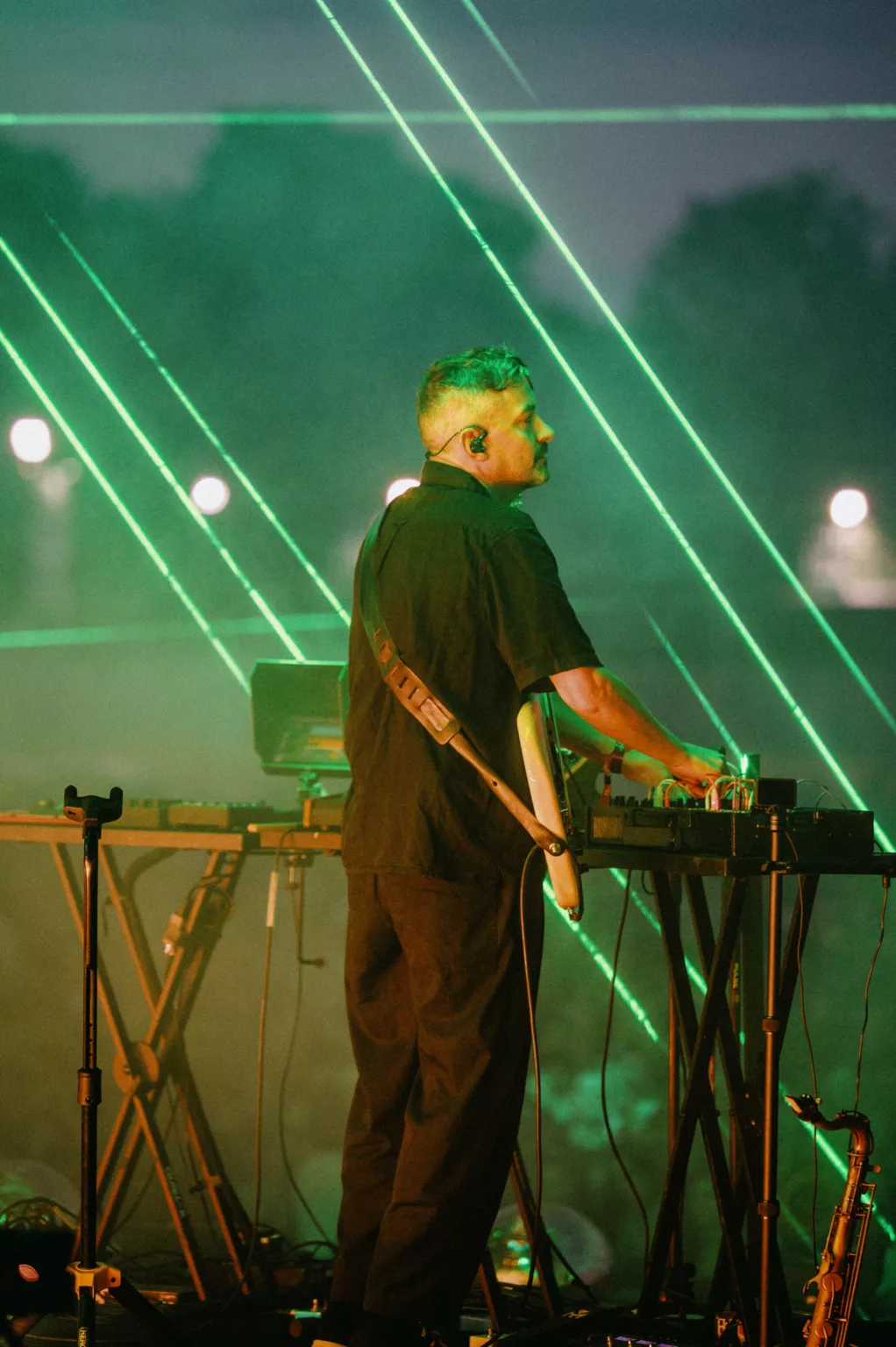
Twelve years later, 69 tracks like ‘Ladies & Gentleman’, ‘Sub Seducer’ and ‘Desire’ aren’t quite standards, but they’ve attained the status of classics. Nevertheless, the 69 live show doesn’t merely reproduce those classics; it reinvents them. Reports from Detroit’s Movement festival describe an unpredictable flood of synth and drum passages leading teasingly towards abandon, before breaking down, switching course and building back up in new ways. Masks and recombinant visuals reinforce both Craig’s love of subterfuge and his roots as a collage artist. Elements of tracks by Tres Demented and other projects are sometimes audible, along with parts of the 69 catalog, but for the most part, rather than a hits reel, it’s a dynamic, spontaneous hardware/software jam; foregoing nostalgia, Craig keeps things pointed squarely into the future, just like he always has. Less a “reunion” that a rebirth, it’s a fitting expression of the spirit of 69, those two little digits orbiting each other like the ends of an infinity symbol.

Posted 28.06.2011

Share this post:

  • email
  • Twitter
  • Google Bookmarks
  • Facebook